The Abraham Accords: National Security, Regional Order and Popular Representation
Now available for purchase online in hardcover and eBook from Amazon & Lexington Press as well as from major retailers.
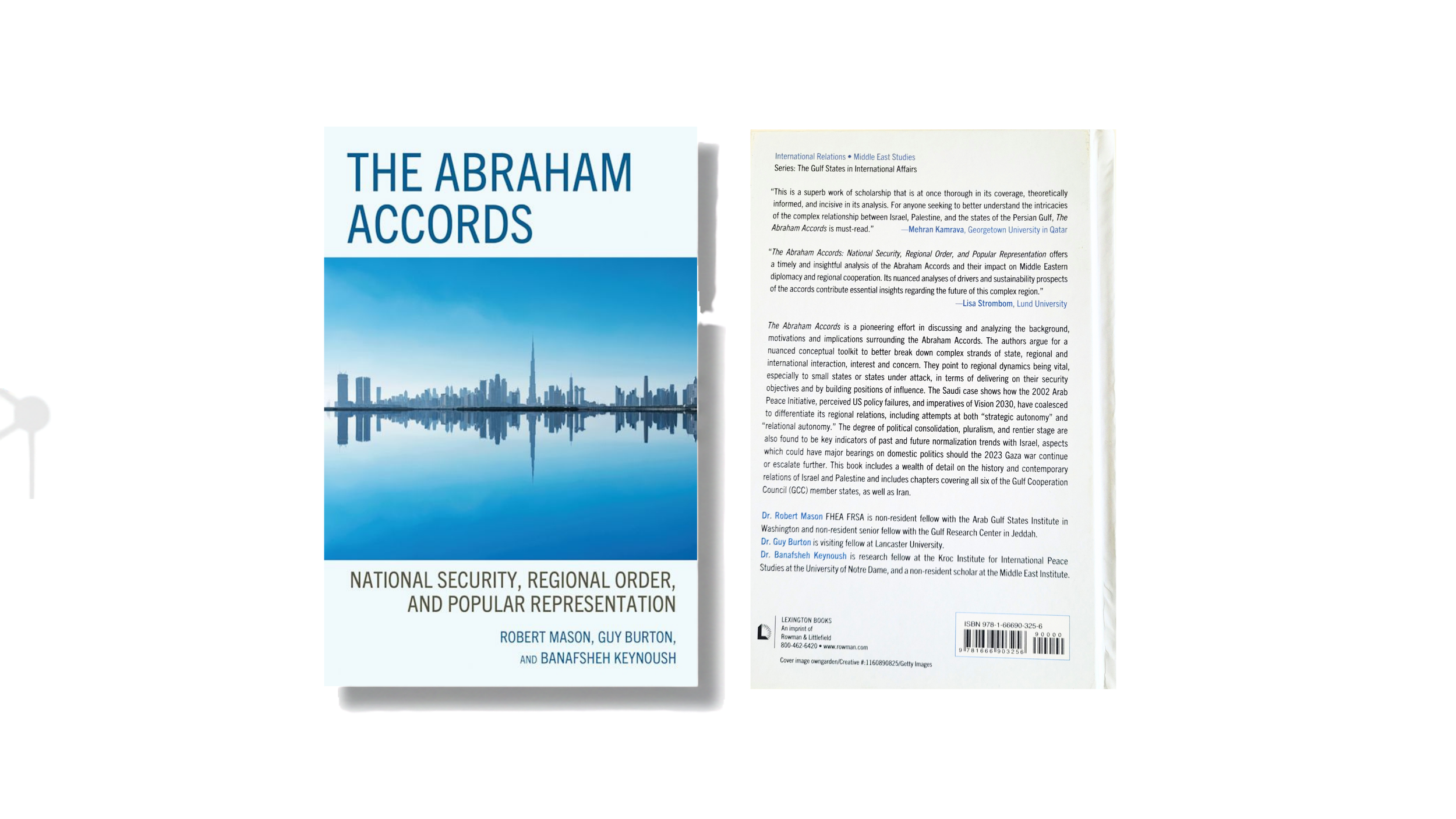
This book examines the background, motives, and implications of the Abraham Accords, offering a nuanced toolkit to analyze state, regional, and international interactions. It stresses regional dynamics’ importance for small or threatened states seeking security and influence. The Saudi case shows how the 2002 Arab Peace Initiative, perceived US failures, and Vision 2030 shaped its regional stance, including moves toward “strategic” and “relational” autonomy. Political consolidation, pluralism, and rentier status are key predictors of normalization with Israel and could affect domestic politics if the 2023 Gaza war continues. The book provides detailed history and contemporary analysis of Israel–Palestine and chapters and their relations with all six GCC states and Iran.
Published by Rowman & Littlefield, 2025
Reviews
“This is a superb work of scholarship that is at once thorough in its coverage, theoretically informed, and incisive in its analysis. For anyone seeking to better understand the intricacies of the complex relationship between Israel, Palestine, and the states of the Persian Gulf, The Abraham Accords is a must-read.”
— Mehran Kamrava, Georgetown University Qatar
“The book offers a timely and insightful analysis of the Abraham Accords and its impact on Middle Eastern diplomacy and regional cooperation. Its nuanced analyses of drivers and sustainability prospects of the accords contribute essential insights regarding the future of this complex region.”
― Lisa Strombom, Lund University
The World Powers and Iran: Before, During and After the Nuclear Deal
Now available for purchase online in hardcover and eBook from Amazon and Palgrave Macmillan as well as from major retailers.

This book shows how and why the Islamic Republic of Iran challenged the world powers to advance a nuclear program. It explores Iran’s interactions with the United States of America, the Russian Federation, the People’s Republic of China, the United Kingdom of Great Britain and Northern Ireland, the French Republic, the Federal Republic of Germany, and the Republic of India, in the period before (2011-2012), during (2013-2015) and after (2016-2021) the finalization of the nuclear deal known as the Joint Comprehensive Plan of Action in 2015. Iran’s narratives and actions are analyzed through its attempts to reshape global politics and the future of the nuclear non-proliferation regime.
Published by Palgrave Macmillan, 2022
Reviews
“Amid much noise and misunderstanding over Iran’s foreign relations and its nuclear program, Banafsheh Keynoush has produced a solid work of scholarship on these two related topics. Zeroing in on Iran’s relations with India, China, the US, the EU, and Russia, she examines Iran’s foreign policy with insight and in depth. This excellent addition to the scholarship should be required reading for all students, experts, and policymakers interested in understanding Iran’s relations with the world powers.”
“Banafsheh Keynoush has written a rich account of Iranian relations with great powers over the last ten years. The book builds on conversations with former policymakers in the United States and abroad, and provides a useful lens for understanding the challenges in reviving the nuclear deal.”
“This book delivers an insightful examination of Iran’s nuclear program and the nuances of its important bilateral relationships with major powers. Through the lens of international relations theories, Keynoush’s argument that Iran, as a middle power, was able to change the position of great powers is welcome to both IR theory and Middle East politics.”
“Few thinkers are as qualified as Banafsheh Keynoush to offer a critical reflection of Iran’s place in the world. Her latest book offers a sweeping analysis of Iran’s nuclear programme in the context of Tehran’s engagement with global politics. This hugely ambitious tome offers a timely insight into Iran’s actions on the world stage and should be essential reading for all Western diplomats engaging with Iran about the nuclear question.”
“In this rigorously researched book, Keynoush deftly unpacks Iran’s nuclear calculations over the course of the last decade. As Keynoush tracks the competing policy argument in Tehran, she shows how Iran continues to wrestle with identifying and protecting what it considers to be its national interests on the regional and global stages. This informative book is a much welcome addition to the literature on Iranian national security policy-making.”
“Dr. Keynoush makes an important contribution to our understanding of Iranian foreign policy. Placing Tehran’s involvement in the Joint Comprehensive Plan of Action (JCPOA) within a broader global context, there are highly informative chapters on Iran’s bilateral relations worldwide, especially those with China, India, and Russia that often do not get the attention they deserve. This excellent book deserves wide readership.”
“This volume is a valuable and timely analysis of Iran’s perspective on the hot-button nuclear issue in its relations with the full range of major powers == the U.S., the EU, Russia, China, and even India == over the entire past decade. It has the added virtue of striving to place all of this factual material into appropriate theoretical frameworks, and the even greater virtue of acknowledging where and when such theories fall short. A prime case in point, the author shows, is the enduring hostility between Iran and the U.S., which reflects a complex and fluid mixtures of ideologies and interests that do not fit neatly into any preconceived categories.”
“The volume is fresh in its tone, measured in its analysis, and clear-eyed in its conclusions, doubled by a simple, direct, and practical set of guidelines for dealing with Iran. The most valuable conclusion is that offensive realism can be practiced successfully even by second-tier powers.”
Iran’s Interregional Dynamics in the Near East
Now available for purchase online in hardcover, softcover, and eBook from Amazon and Peter Lang as well as from major retailers.
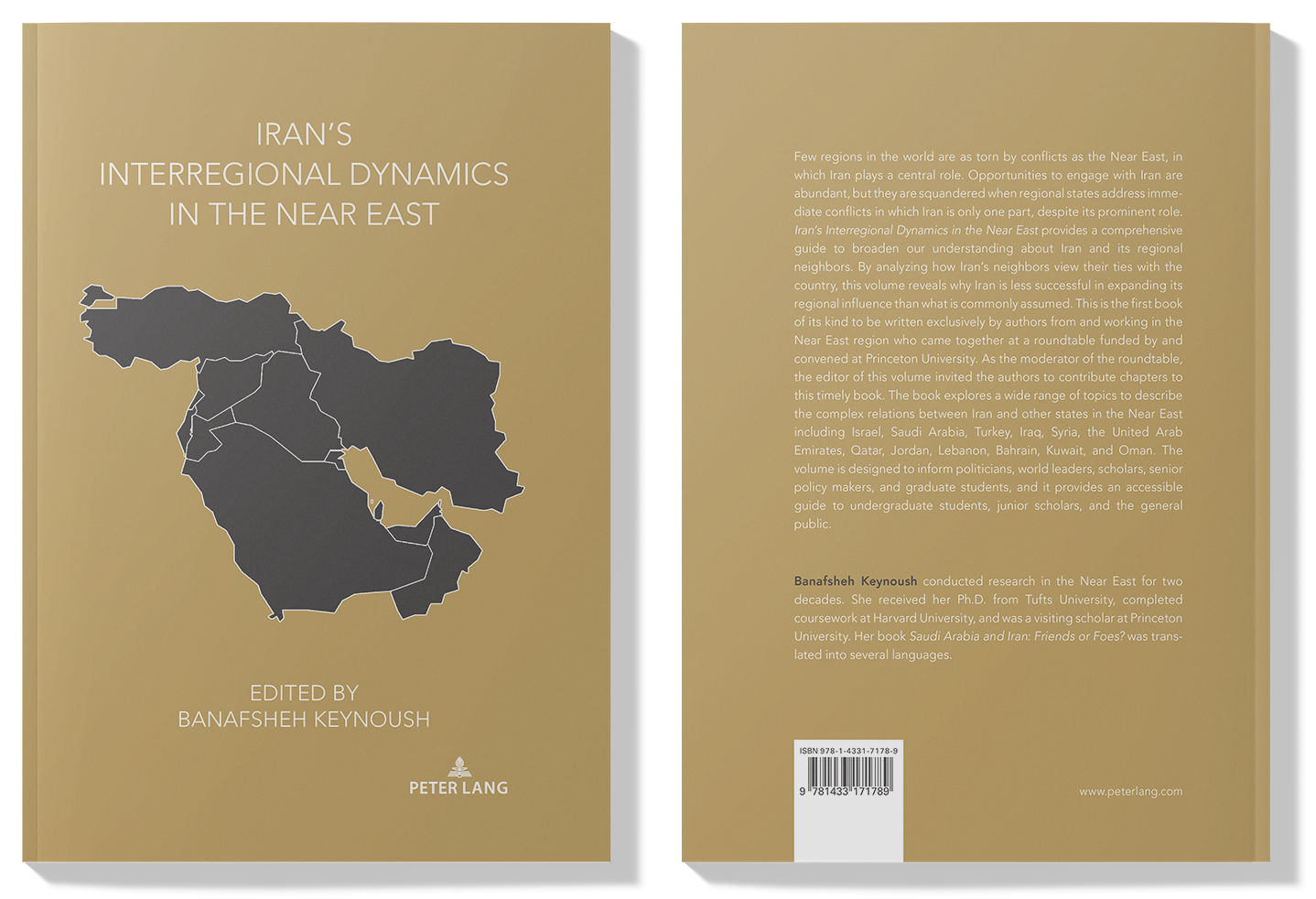
Few regions in the world are as torn by conflicts as the Near East, in which Iran plays a central role. Opportunities to engage with Iran are abundant, but they are squandered when regional states address immediate conflicts in which Iran is only one part, despite its prominent role. Iran’s Interregional Dynamics in the Near East provides a comprehensive guide to broaden our understanding about Iran and its regional neighbors. By analyzing how Iran’s neighbors view their ties with the country, this volume reveals why Iran is less successful in expanding its regional influence than what is commonly assumed. This is the first book of its kind to be written exclusively by authors from and working in the Near East region who came together at a roundtable funded by and convened at Princeton University. As the moderator of the roundtable, the editor of this volume invited the authors to contribute chapters to this timely book. The book explores a wide range of topics to describe the complex relations between Iran and other states in the Near East including Israel, Saudi Arabia, Turkey, Iraq, Syria, the United Arab Emirates, Qatar, Jordan, Lebanon, Bahrain, Kuwait, and Oman. The volume is designed to inform politicians, world leaders, scholars, senior policy makers, and graduate students, and it provides an accessible guide to undergraduate students, junior scholars, and the general public.
Published by Peter Lang, 2021
Reviews
“Iran’s Interregional Dynamics in the Near East is one of the few books that fully examines how Iran’s neighbors like the Gulf Cooperation Council, Iraq, and Turkey view that country’s foreign policy. It fills a major gap in our understanding of the geostrategic rivalries unfolding in the Middle East. An excellent read.”
“Few subjects are more important, or controversial, in contemporary world affairs than Iran’s alliances and conflicts with its Middle Eastern neighbors. In this book, seasoned experts in the region lay out the key issues in a dispassionate, informed and analytical manner that sheds loads of light on this crucial topic. ”
Saudi Arabia and Iran: Friends or Foes?
Sold over 12,000 copies to date in the English edition in hardcover, softcover, and eBook, and translated into several languages including Arabic and Persian! Now available for purchase online in hardcover, softcover, and eBook from Amazon and Palgrave Macmillan as well as from major retailers. Also available in Arabic and in Persian editions.

In a riveting narrative based on accounts of her interactions with Saudi and Iranian politicians, extensive field work and rich archival material, Banafsheh Keynoush unravels the mysteries of a contentious relationship. Keynoush recounts it all: the fears, misunderstandings, prejudices, and ambitions that have hobbled efforts to build a lasting partnership, creating a work that is important to both the expert and the layperson. Keynoush’s book encouraged international policy makers to focus on the need to restore balanced relations between Saudi Arabia and Iran, and it theoretically refuted views that sectarianism is the cause of tensions between the two Middle Eastern states.
Published by Palgrave Macmillan, 2016
Reviews
“From a Norwegian foreign affairs vantage point, where balancing a reputation as international peacemaker, giant oil producer, and close US ally is the main task, this book offers a refreshing view of the strategic importance of allowing Iran and Saudi Arabia to regain a balanced partnership in pursuit of security and lower ideological tensions. . . a carefully argued revelation.”
“‘Dr. Keynoush’s book makes a timely intervention towards understanding the delicately poised Saudi-Iranian relationship. Extensively researched and historically nuanced in approach, it provides a much needed corrective to studies that view the rivalry between Saudi Arabia and Iran through the sectarian prism in the main. By foregrounding the role of external actors like the United States in the region, and the shifting logic of power politics, the analysis effectively reframes a relationship that remains critical to the stability and security of the Persian Gulf region. A welcome addition to the literature on contemporary politics and international diplomacy, the book ought to be read by students and policy makers of the Middle East.”
CHAPTERS IN BOOKS
Regional Consequentialism and Iran’s Marja'iyat: A View from Tehran
Banafsheh Keynoush, in The Shi'a in the Modern Arab World: Between History and Autonomy, edited by Geneive Abdo
Now available for purchase online in hardcover and eBook from Amazon and American University in Cairo Press as well as from major retailers.
Published by American University in Cairo Press, 2026
Reviews
“This is a book of tremendous value, focusing on an understudied and often misunderstood population. Abdo and her contributors map out the historic marginalization of the Arab Shi’a across the Middle East, and their increasing autonomy and penchant for political contestation in recent decades. This is all within the context of a precarious relationship with the Iranian marja’iyat that seeks to assert itself as the religious leader of the community. The book is key to understanding the psotion of contemporary Shi’ism in the Middle East and beyond.”
— Mehran Kamrava, Georgetown University in Qatar
“A much needed examination of the Shi’i condition from its multiple regional angles, by authors most of whom hail from the broader Middle East or live in it. Genuinely interesting and very timely."
— Michael Young, Malcolm H. Kerr Carnegie Middle East Center, Beirut
"The Arab Shi‘a have been securitized for decades, framed as a fifth column, an 'Iranian proxy,' or a threat to be managed rather than citizens with their own agency. The contributors to this book reveal a generation renegotiating what it means to be Shi‘a and Arab: asserting religious and political autonomy, challenging their own political establishments, and refusing the narratives determined by the security concerns of external actors. Rigorous, grounded, and more relevant than ever."
— Marc Owen Jones, Northwestern University in Qatar
"This thoughtful editorial vision has produced an outstanding and much-needed volume.It shows how, despite centuries of marginalization and misunderstanding, Arab Shi‘a communities have emerged as dynamic actors shaping the religious, political, and intellectual landscape of the modern Middle East. A significant contribution to Shi‘a studies and contemporary Islamic studies."
— Hassan Abbas, author of The Prophet's Heir: The Life of Ali Ibn Abi Talib
Iran's Northern Corridors: Implications for National Security, Regional Order, and the Look East Policy
Banafsheh Keynoush, in Iran’s Look East Policy, edited by Mehran Kamrava
Now available for purchase online in hardcover, softcover, and eBook from Amazon and Cornell University Press as well as from major retailers.
Published by Cornell University Press, 2026
Reviews
“Iran's Look East Policy is the first serious academic treatment in English of the genesis, development, and implications of the Islamic Republic's "Look East" foreign policy. The book provides vital interpretations of Iran's policy that Western publications downplay or ignore.”
— Nader Entessar, University of South Alabama
“The essays in Iran's Look East Policy ooze quality. Mehran Kamrava has carefully assembled an international mix of established and emerging scholars and subject experts. The reader is exposed to a variety of approaches. The eclecticism of the volume is a further strength for me.”
— Anoush Ehteshami, Durham University
Narratives of Power Politics in Iran-Saudi Relationship
Banafsheh Keynoush, Edward Wastnidge, in Saudi Arabia and Iran: The Struggle to Shape the Middle East, edited by Simon Mabon & Edward Wastnidge
Now available for purchase online in hardcover, softcover, and eBook from Amazon and Manchester University Press as well as from major retailers.
Published by Manchester University Press, 2022
Reviews
'This is an impressive volume in its scope and its ability to capture nuance in a relationship that is often subject to generalisations and simplified analysis. Wastnidge and Mabon have assembled a solid group of scholars who have managed to make an important and original contribution to a topic that has lately been studied a great deal. I strongly recommend this book for anyone interested in a serious understanding of the complex relationship between Saudi Arabia and Iran.'
— Mehran Kamrava, Professor of Government, Georgetown University Qatar
”Not only does this volume provide a fascinating account of how the Saudi-Iranian rivalry has played out across time and space and impacted regional and domestic politics across the Middle East. It also shows how a stronger dialogue between IR theory and Middle East studies can offer insights into Middle East politics that go beyond the well-known politics v. piety debate.”
— Morten Valbjørn, Associate Professor, Department of Political Science, Aarhus University
Quisque iaculis facilisis lacinia. Mauris euismod pellentesque tellus sit amet mollis.